Selvedin Kurtic & Luis Cabrales, Ph,D
Department of Mechatronics Engineering, California State University, Monterey Bay
Question
Can organic agricultural waste be used as a sustainable filler material for plastics and polymer-based products?
Background
This research project investigates the feasibility of using organic agricultural waste, specifically pistachio shells, as a sustainable filler material for plastics and polymer-based products. Many plastic materials currently rely on using toxic fillers that can be harmful to the environment and are difficult to dispose of. This study explores whether ground pistachio shells can serve as an eco-friendly alternative without reducing material strength and durability. Pistachio shells are an abundant agricultural byproduct that are produced and tossed into large piles by processing facilities. We take the pistachio shells from these processing facilities were cleaned, processed, and ground into powders of different particle sizes. These powders are then mixed with a commodity polymer, low density polyethylene (LDPE), using a Laboratory Mixing Extruder which distributes the powder into the plastic and creates a filament of plastic. Different concentrations of ground pistachio shells were used for samples. The material is then cut and fed into an injection molding machine to create dog-bone samples that were prepared and tested in a tensile testing machine. The Elastic modulus, tensile strength, and elongation at break of the materials were compared for different concentrations of pistachio shell powder to determine how filler content can affect the performance and overall composite of the material.
Materials
Pistachio Shells [Fig. 1]
Sieve Pans
Low-Density Polyethylene
Laboratory Oven
Laboratory Mixing Extruder [Fig. 2]
Injection Molding Machine
Tensile Test Molds [Fig. 3]
Instron Universal Testing Machine [Fig. 4]


Procedure
- Pistachio shells are soaked, cleaned, separated, and dried in a laboratory oven.
- The dried shells are then ground and sieved through 60, 120, and 230 Mesh screens to obtain powders of varying particle sizes.
- Measured percentages of pistachio powder were mixed with 50 g of LDPE and processed through a mixing extruder until a uniform blend was achieved.
- The resulting mixture was injection molded into tensile testing specimens.
- The specimens were then testing using an Instron 68TM-30 universal testing machine.
Results


Conclusion
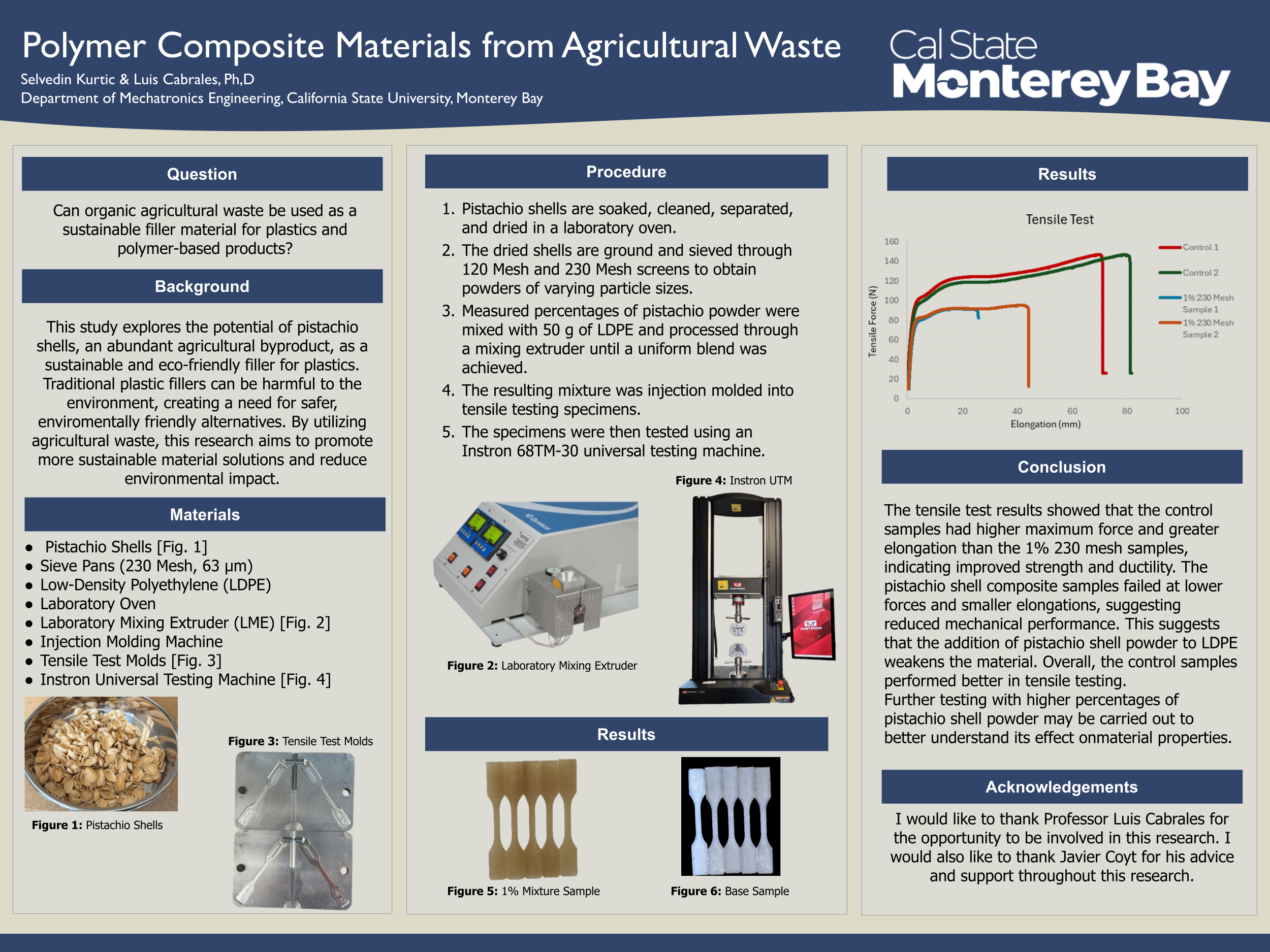
The tensile test results showed that the control samples had higher maximum force and greater elongation than the 1% 230 mesh samples, indicating improved strength and ductility. The pistachio shell composite samples failed at lower forces and smaller elongations, suggesting reduced mechanical performance. This suggests that the addition of pistachio shell powder to LDPE weakens the material. Overall, the control samples performed better in tensile testing.
Further testing with higher percentages of pistachio shell powder may be carried out to better understand its effect on material properties.
Acknowledgements
I would like to thank Professor Luis Cabrales for the opportunity to be involved in this research. I would also like to thank Javier Coyt for his advice and support throughout this research.